Much of modern cryptographic education emphasizes formal definitions, such as Shannon’s characterization of perfect secrecy. These are often presented as fixed endpoints rather than models derived from specific assumptions.
The system we present here emerged from an implementation-driven approach, where the design process was guided by the practical goal of eliminating observable information leakage during decryption, rather than by satisfying a predefined formalism. This raises a broader question: "Should perfect secrecy be understood exclusively through its classical probabilistic formulation, or can it also be realized operationally in systems that achieve the same informational outcome through different structural mechanisms?" We argue that exploring such alternatives not only deepens our understanding of perfect secrecy but also enriches the theoretical framework itself.
Rather than redefining Shannon's result, this work invites examinations of whether alternative constructions can realize the same condition: I(P;C) = 0, and how such systems should be interpreted within the existing theoretical framework.
To clarify any misunderstanding from the outset, we do not oppose Shannon’s work. Instead, we seek to expand the discussion and frame our approach as an exploration of possibilities, not a contradiction. Shannon tells us when perfect secrecy exists, but the question for us was of how, and whether alternative mechanisms can achieve the same outcome and remains open.
-----*-----
To achieve OTP security we need:
1. A Key that is truly random
2. A Key as long as "All" messages to be sent
3. Each part of the Key is only used once
4. The Key is kept completely secret
To achieve security with our system we need:
1. A random permutation of n! possible permutations (characters in
chosen alphabet provide possible permutation).
2. The permutation is kept completely secret.
OTP :
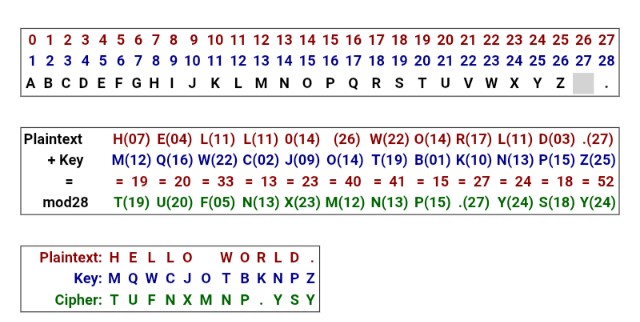
We will use the 26-character English alphabet and add a space character and a punctuation mark. With that, the modulus changes from 26 to 28 when using modular arithmetic. The text we encrypt: HELLO WORLD.
We have a plaintext, a key, a cipher, but have created now another problem, which in cryptography is called the key distribution problem. We have to find an absolute secure channel to transmit the key, enabling a lawful recipient of our cipher to decrypt it. We also notice that the amount of data we have to transmit has doubled when comparing it with the plaintext.
Let's find out if our system can change the one assumption for the OTP, that according to experts makes it useless (key length and the secure transmission of it) and still comply with Shannon's theorem I(P;C)=0.
-----*-----
Our system :
HELLO WORLD. - H(48) E(45) L(4C) L(4C) O(4F) (20) W(57) O(4F) R(52) L(4C) D(44) .(2E)
1. Start and key permutations are chosen (random).
2. Plaintext is mapped on the current permutation.
3. Substring from the front to that character is
taken, reversed, and appended to the end.
4. Index values are recorded.
5. Loops are applied to the index sequence.
6. Key character is added (1/16 shift).
7. Cipher characters are produced.
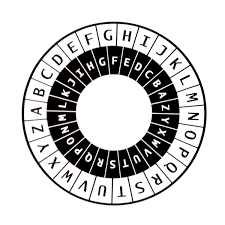
The images below show two Alberti Disks, one with the English alphabet and the second one with the hexadecimal alphabet. On the disk outside of the disks, we have placed the alphabet ordered A - Z and from 0 to F clockwise, on the inside the alphabets (randomized in the hexadecimal disk). It is intended to help readers to understand the steps taken in our system during encryption.
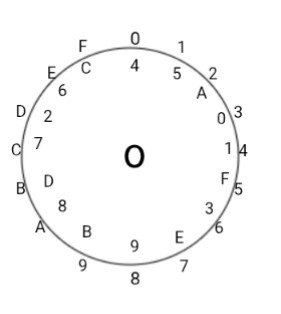
The PIN code contains the first character of the plaintext. We use it to place the start permutation into the position, which permits us to select end position and the next start position in the next permutation.
HELLO WORLD. - H(48) E(45) L(4C) L(4C) O(4F) (20) W(57) O(4F) R(52) L(4C) D(44) .(2E)
| Secret hex | X | X | X | X | X | X | X | X | X | X | X | X | X | X | X | X | ||
|---|---|---|---|---|---|---|---|---|---|---|---|---|---|---|---|---|---|---|
| Start Permutation | C | 6 | 2 | 7 | D | 8 | B | 9 | E | 3 | F | 1 | 0 | 4 | 5 | A | ||
| Key Permutation; | 7 | 8 | D | C | 2 | 6 | 5 | 0 | 9 | F | 3 | E | 1 | B | A | 4 | ||
Legend:
<-- Arrow shows the direction the permutation moves
Two characters behind the arrow:
1. The first showing the character moving to position 0
2. The next, the characters moving to the end in reversed order.
The last two items show Start or End permutation and the Index obtained.
| Hex | 0 | 1 | 2 | 3 | 4 | 5 | 6 | 7 | 8 | 9 | A | B | C | D | E | F | Start | Index = 4 | |||
|---|---|---|---|---|---|---|---|---|---|---|---|---|---|---|---|---|---|---|---|---|---|
| Permutation | C | 6 | 2 | 7 | D | 8 | B | 9 | E | 3 | F | 1 | 0 | 4 | 5 | A | <- | 8 | D | End | Index = 4 |
| - | - | - | - | - | - | - | - | - | - | - | - | - | - | - | - | - | - | - | - | - | |
| 8 | B | 9 | E | 3 | F | 1 | 0 | 4 | 5 | A | D | 7 | 2 | 6 | C | <- | 4 | 0 | Start | Index = 7 |
Start 4 - End 4 = 44 = H = 48
| Iteration 001 | 0 | 1 | 2 | 3 | 4 | 5 | 6 | 7 | 8 | 9 | A | B | C | D | E | F | <- | 4 | 8 | Start | |
|---|---|---|---|---|---|---|---|---|---|---|---|---|---|---|---|---|---|---|---|---|---|
| Iteration 001 | 4 | 5 | A | D | 7 | 2 | 6 | C | 0 | 1 | F | 3 | E | 9 | B | 8 | <- | 0 | 5 | End | Index = 0 |
| - | - | - | - | - | - | - | - | - | - | - | - | - | - | - | - | - | - | - | - | - | |
| 5 | A | D | 7 | 2 | 6 | C | 0 | 1 | F | 3 | E | 9 | B | 8 | 4 | <- | 4 | 8 | Start | Index = E |
Start 7 - End 0 = 70 = E = 45
| Iteration 002 | 0 | 1 | 2 | 3 | 4 | 5 | 6 | 7 | 8 | 9 | A | B | C | D | E | F | |||||
|---|---|---|---|---|---|---|---|---|---|---|---|---|---|---|---|---|---|---|---|---|---|
| Iteration 002 | 4 | 8 | B | 9 | E | 3 | F | 1 | 0 | C | 6 | 2 | 7 | D | A | 5 | <- | C | 0 | End | Index = 8 |
| - | - | - | - | - | - | - | - | - | - | - | - | - | - | - | - | - | - | - | - | - | |
| C | 6 | 2 | 7 | D | A | 5 | 0 | 1 | F | 3 | E | 9 | B | 8 | 4 | <- | 4 | 8 | Start | Index = E |
Start E - End 8 = E8 = L = 4C
| Iteration 002 | 0 | 1 | 2 | 3 | 4 | 5 | 6 | 7 | 8 | 9 | A | B | C | D | E | F | |||||
|---|---|---|---|---|---|---|---|---|---|---|---|---|---|---|---|---|---|---|---|---|---|
| Iteration 003 | 4 | 8 | B | 9 | E | 3 | F | 1 | 0 | 5 | A | D | 7 | 2 | 6 | C | <- | C | 6 | End | Index = E |
| - | - | - | - | - | - | - | - | - | - | - | - | - | - | - | - | - | - | - | - | - | |
| C | 6 | 2 | 7 | D | A | 5 | 0 | 1 | F | 3 | E | 9 | B | 8 | 4 | <- | 4 | 8 | Start | Index = E |
Start E - End E = EE = L = 4C
| Iteration 002 | 0 | 1 | 2 | 3 | 4 | 5 | 6 | 7 | 8 | 9 | A | B | C | D | E | F | |||||
|---|---|---|---|---|---|---|---|---|---|---|---|---|---|---|---|---|---|---|---|---|---|
| Iteration 004 | 4 | 8 | B | 9 | E | 3 | F | 1 | 0 | 5 | A | D | 7 | 2 | 6 | C | <- | F | 3 | End | Index = 5 |
| - | - | - | - | - | - | - | - | - | - | - | - | - | - | - | - | - | - | - | - | - | |
| F | 1 | 0 | 5 | A | D | 7 | 2 | 6 | C | 3 | E | 9 | B | 8 | 4 | <- | 2 | 7 | Start | Index = 6 |
Start E - End 5 - E5 = O = 4F
| Iteration 005 | 0 | 1 | 2 | 3 | 4 | 5 | 6 | 7 | 8 | 9 | A | B | C | D | E | F | |||||
|---|---|---|---|---|---|---|---|---|---|---|---|---|---|---|---|---|---|---|---|---|---|
| Iteration 005 | 2 | 6 | C | 3 | E | 9 | B | 8 | 4 | 7 | D | A | 5 | 0 | 1 | F | <- | 0 | 5 | End | Index = C |
| - | - | - | - | - | - | - | - | - | - | - | - | - | - | - | - | - | - | - | - | - | |
| 0 | 1 | F | 5 | A | D | 7 | 4 | 8 | B | 9 | E | 3 | C | 6 | 2 | <- | 5 | 2 | Start | Index = 2 |
Start = 6 - End = C - 6C = Space = 20
| Iteration 006 | 0 | 1 | 2 | 3 | 4 | 5 | 6 | 7 | 8 | 9 | A | B | C | D | E | F | |||||
|---|---|---|---|---|---|---|---|---|---|---|---|---|---|---|---|---|---|---|---|---|---|
| Iteration 006 | 5 | A | D | 7 | 4 | 8 | B | 9 | E | 3 | C | 6 | 2 | F | 1 | 0 | <- | 7 | D | End | Index = 2 |
| - | - | - | - | - | - | - | - | - | - | - | - | - | - | - | - | - | - | - | - | - | |
| 7 | 4 | 8 | B | 9 | E | 3 | C | 6 | 2 | F | 1 | 0 | D | A | 5 | <- | 4 | 7 | Start | Index = 0 |
Start = 2 - End = 0 = 20 = W = 57
| Iteration 007 | 0 | 1 | 2 | 3 | 4 | 5 | 6 | 7 | 8 | 9 | A | B | C | D | E | F | |||||
|---|---|---|---|---|---|---|---|---|---|---|---|---|---|---|---|---|---|---|---|---|---|
| Iteration 007 | 4 | 8 | B | 9 | E | 3 | C | 6 | 2 | F | 1 | 0 | D | A | 5 | 7 | <- | F | 2 | End | Index = 8 |
| - | - | - | - | - | - | - | - | - | - | - | - | - | - | - | - | - | - | - | - | - | |
| F | 1 | 0 | D | A | 5 | 7 | 2 | 6 | C | 3 | E | 9 | B | 8 | 4 | <- | 5 | A | Start | Index = 4 |
Start = 0 - End = 8 - 08 = O = 4F
| Iteration 008 | 0 | 1 | 2 | 3 | 4 | 5 | 6 | 7 | 8 | 9 | A | B | C | D | E | F | |||||
|---|---|---|---|---|---|---|---|---|---|---|---|---|---|---|---|---|---|---|---|---|---|
| Iteration 008 | 5 | 7 | 2 | 6 | C | 3 | E | 9 | B | 8 | 4 | A | D | 0 | 1 | F | <- | 2 | 7 | End | Index = 1 |
| - | - | - | - | - | - | - | - | - | - | - | - | - | - | - | - | - | - | - | - | - | |
| 2 | 6 | C | 3 | E | 9 | B | 8 | 4 | A | D | 0 | 1 | F | 7 | 5 | <- | 4 | 8 | Start | Index = 7 |
Start = 4 - End = 1 - 41 = R = 52
| Iteration 009 | 0 | 1 | 2 | 3 | 4 | 5 | 6 | 7 | 8 | 9 | A | B | C | D | E | F | |||||
|---|---|---|---|---|---|---|---|---|---|---|---|---|---|---|---|---|---|---|---|---|---|
| Iteration 009 | 4 | A | D | 0 | 1 | F | 7 | 5 | 8 | B | 9 | E | 3 | C | 6 | 2 | <- | C | 3 | End | Index = C |
| - | - | - | - | - | - | - | - | - | - | - | - | - | - | - | - | - | - | - | - | - | |
| C | 6 | 2 | 3 | E | 9 | B | 8 | 5 | 7 | F | 1 | 0 | D | A | 4 | <- | 4 | A | Start | Index = E |
Start = 7 - End = C - 7C = L = 4C
| Iteration 010 | 0 | 1 | 2 | 3 | 4 | 5 | 6 | 7 | 8 | 9 | A | B | C | D | E | F | |||||
|---|---|---|---|---|---|---|---|---|---|---|---|---|---|---|---|---|---|---|---|---|---|
| Iteration 010 | 4 | A | D | 0 | 1 | F | 7 | 5 | 8 | B | 9 | E | 3 | 2 | 6 | C | <- | 4 | C | End | Index = F |
| - | - | - | - | - | - | - | - | - | - | - | - | - | - | - | - | - | - | - | - | - | |
| 4 | C | 6 | 2 | 3 | E | 9 | B | 8 | 5 | 7 | F | 1 | 0 | D | A | <- | 2 | 6 | Start | Index = 2 |
Start = E - End = F - EF = D = 44
| Iteration 011 | 0 | 1 | 2 | 3 | 4 | 5 | 6 | 7 | 8 | 9 | A | B | C | D | E | F | |||||
|---|---|---|---|---|---|---|---|---|---|---|---|---|---|---|---|---|---|---|---|---|---|
| Iteration 011 | 2 | 3 | E | 9 | B | 8 | 5 | 7 | F | 1 | 0 | D | A | 6 | C | 4 | <- | E | 3 | End | Index = 1 |
| - | - | - | - | - | - | - | - | - | - | - | - | - | - | - | - | - | - | - | - | - | |
| - | - | - | - | - | - | - | - | - | - | - | - | - | - | - | - | - | - | - | - | - |
Start = 2 - End = 1 - 21 = Full Stop . = 2E
The Achilles’ Heel of the One-Time Pad encryption has always been the 'Key Transmission', its fatal flaw. With it 'Perfect secrecy' comes at a cost, because the key must be as long as the plaintext and transmitted securely.
Text: 48 45 4C 4C 4F 20 57 4F 52 4C 44 2E
Index: 44 70 E8 EE E5 6C 20 08 41 7C EF 21
+Key: 78 DC 26 50 9F 3E 1B A4 78 DC 26 50
Cipher: BC 4C .................
We have 12 ASCII characters (HELLO WORLD. = 24 hex characters = Plaintext) and 24 indices (index characters = transposition characters = each a position value and not the index value on a single unique permutation).
There is no need to pair the transposition characters with a random key character, but we did it with the first four characters to show the problem when trying to decrypt (break) the cipher characters (each has a 1/16 probability). The four boxes that follow the mathematical reasoning and our questions for readers should make that clear.
Mathematical Reasoning:
The set of all permutations satisfies Shannon's second condition: For any plaintext letter x and any ciphertext letter y, there exist exactly (16−1)! = 15! permutations that map x to y. Since every key is chosen with equal probability (1/16!), the probability of mapping x to y is:
15! 1
16! 16
=
Perfect Secrecy follows provided the following two mathematical conditions hold for every character.
1. Independent Random Selection:
We must select a new, independent generated permutation (key) for each character from the set of all 16! possible permutations, with uniform probability. We cannot reuse a permutation or derive the next one from the previous one using a short seed (which would make it a stream cipher, not a one-time pad).
2. Unique Mapping Property
The set of all permutations satisfies Shannon's second condition. For every plaintext symbol x and ciphertext symbol y, exactly 15! permutations that map x to y. Consequently,
P(y|x) =
15! 1
16! 16
=
Why It Works
This system is effectively a "One-Time Pad" where the operation is permutation substitution instead of modular addition (XOR).
We have here "Key Space vs. Message Space" :
For a message of length N, our key space is (16!)N, which is vastly larger than the message space (16N).
Entropy: Because each character is encrypted with a completely independent, maximally entropic key (a random permutation), the a posteriori probability of every plaintext symbol equals its prior probability. Under a uniform prior this probability is 1/16.
One word of caution here:
If you reuse permutations or use a deterministic algorithm to generate the sequence of permutations from a short key, the proof of perfect secrecy no longer applies, because the keys are no longer independent random variables.
This probability is constant for all pairs (x,y), ensuring that the ciphertext reveals zero information about the plaintext.
* * * - * * *
Some questions placed here for students and newcomers to cryptography. By using the above example and examining the following mathematical try reasoning and Outline a Logical Proof, or tell us why it should fail.
1. Identify the possible key removals.
2. Derive the possible index values that derive.
3. Consider the pair expansions represented by those indexes.
4. Account for unknown loop counts. (only required on page 2)
5. Determine whether a unique start permutation can be derived
or whether multiple or all plaintext histories remain possible.
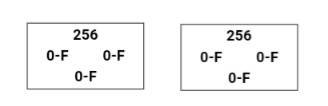
The 4 boxes above represent our four cipher characters: B C 4 C and the probabilities they represent, when tested against one permutation.
* * * - * * *
The final part reflects some of the thoughts that stayed with us as we returned to this paper again and again. To us, this is what science is about; questioning, re-evaluating, adjusting and sometimes changing ideas, theories, or theorems.
The fundamental structures in science (physics, chemistry, biology, etc.) sometimes elude us. They can appear mysterious, withholding some of their secrets and refusing the rules we try to impose upon them. Throughout history, conflicts between new theories, experimental data, and established beliefs have often been ignored or dismissed because they did not fit the accepted way of thinking. This attitude is frequently reflected in phrases such as “everyone knows” or “everyone should know.”
Discarding new ideas prematurely can be costly in the long run and, in our view, is almost always a mistake.
Of course, new theories must be tested rigorously and meticulously, but the same standard must also apply continuously to existing theories. If we fail to do this, we risk leaving the path of science and moving instead toward complacency.
In physics, for example, we know about the coexistence of Albert Einstein’s relativity and Werner Heisenberg’s quantum mechanics. Both are experimentally successful in their domains, but the problem is that they are difficult to reconcile completely under one unified framework.
The question emerging for us was: "Can cryptography hold possibilities which would allow different theorems to co-exist, generating ciphers in compliance with Shannon's mathematical proof of Perfect Secrecy." For this reason we put a question in front of 6 AI systems and 5 academics (mathematicians teaching at universities). The question will lead us back to Claude Shannon and his mathematical-theoretical proof of Perfect Secrecy and also the three axioms he formulated for his entropy function H:
Let's assume we have a plaintext string of random characters and a key string that only consists of 26 characters. The plaintext uses the same alphabet as the key string, but is 10.000 random characters in length. How would an attacker try to crack a cipher created, using modular arithmetic and what would be the result of this attempt?
The answers we received from the academics concluded, without exception, that the cipher would provide no reasonable information for an attacker.
The first replies from the AI systems all defaulted to Claude Shannon's mathematical theoretical framework and his entropy function (H). The conclusion was based on the fact that the length of the key (26 characters) did not match the length of the plaintext (10,000 characters). This, they argued, would inevitably lead to patterns and frequencies which could be explored.
However, it showed us that the question was not fully understood by the AI systems. Their answers were based on available information in their memory or locations on the internet. Not taking into account that the plaintext already was a random string, holding no statistical data that could be exploited. For that reason, we had to ask an additional question, which was:
Show us the pattern or frequencies in a cipher when
1. The plaintext consists of randomly selected characters (alphabet of 26)
2. The key using the same alphabet
3. Each plaintext character is paired with a randomly selected key character and modular arithmetic applied to create a cipher character.
4. How would the use of a shorter key (assuming we have selected 4 characters randomly from the alphabet) and a randomly selected part of the plaintext have been paired with them affect the cipher? The "where" of the plaintext characters paired unknown and "which" of the 4 characters used.
After facing this question, the AI system agreed that the problem could not be solved and this moves us back to Claude Shannon and the three axioms he postulated for his evaluation of the Vernam Cipher (re-branded OTP later) and the four key requirements which you will not find in his papers. These requirements were a later addition by mathematicians and cryptographers for pedagogical or educational teaching purposes.
1. A key that is truly random
2. A Key as long as "All" messages to be sent
3. Each part of the Key is only used once
4. The Key is kept completely secret
Shannon's entropy function H (3 axioms) explaining function H to be a measure of a message A and the information it contains:
1. It should be continuous in the P(ai), where P is a probability.
2. It increases monotonically with N if P(ai) = 1/N
3. It satisfies the decomposition rule for joint entropy of two discrete random variables.
One sentence we found missing in Shannon's papers, which have been re-published and interpreted on different websites to explain his entropy H function and its connection with the Vernam system and the required Markov process:
*You will find it in "A Mathematical Theory of Cryptography, Claude E. Shannon — Published September 1945", which was one precursor to the final version published in the Bell System Technical Journal in October 1949.
"With N = 1 any letter is clearly possible and has the same a posteriori probability as its a priori probability. For one letter the system is perfect."
The reasons for its removal are unknown to us, but the sentence triggers for us an important and genuinely thought-provoking question:
"If each plaintext character is transformed independently through its own permutation space, without statistical dependence on neighboring characters, does the system still behave like one large Vernam system — or like many isolated one-symbol Vernam systems? And how does it affect the key requirements?"
Let's go back to Shannon and what he said:
11 EQUIVOCATION (Page 683 -- A Mathematical Theory of Cryptography)
Let us suppose that a simple substitution cipher has been used on English text and that we intercept a certain amount, N letters, of the enciphered text. For N fairly large, more than say 50 letters, there is nearly always a unique solution to the cipher; i.e., a single good English sequence which transforms into the intercepted material by a simple substitution. With a smaller N, however, the chance of more than one solution is greater: with N = 15 there will generally be quite a number of possible fragments of text that would fit, while with N = 8 a good fraction (of the order of 1 8) of all reasonable English sequences of that length are possible, since there is seldom more than one repeated letter in the 8. With N = 1 any letter is clearly possible and has the same a posteriori probability as its a priori probability. For one letter the system is perfect.
Does the paragraph not point to Shannon’s concern about language statistics and Markov dependencies? In ordinary language, letters are correlated, words are correlated and structure leaks information. His paper rigorously defines perfect secrecy as the condition where a ciphertext provides no information about the plaintext, which is mathematically true for a single character encrypted with a unique, random key (like in a One-Time Pad), but also true for a single transposed character using a random permutation of the alphabet. The paper also discusses the use of a "suitable Markoff process" to model the statistical properties of the message source and the key source.
Our argument for our transposition system is, if every symbol transformation is isolated, and no transition information propagates between neighboring symbols, then higher-order statistical structure will collapse. That is a serious conceptual point one has to explore.
Here an answer we came up with to the question we formulated above:
In an isolated one-symbol system with each character encrypted independently with its own key (permutation), the security of each character is identical to that of a single-character Vernam cipher (singular event). The ciphertext for one character reveals nothing about that specific plain character, just as in a perfect one-symbol system.
In a large Vernam system, when we combine all these independent encryptions, the overall system is mathematically equivalent to a standard Vernam system (OTP) applied to the entire message. The "key" for a large system is simply the concatenation of all the individual keys (or permutations) used for each character. The requirement for perfect secrecy, that the key space is at least as large as the message space and is used only once, is fully satisfied.
Therefore we state (and this is a hypothesis/theory and not a claim we make), systems like these achieve perfect secrecy as defined by Shannon. The independence of the permutations ensures that the statistical properties of the plaintext (like letter frequency) are completely masked, and an attacker, even with infinite computational power, cannot determine the original message from the ciphertext alone, as every possible plaintext of the same length remains equally probable.
* * * - * * *
The first item to mention at this point is to thank all readers who reached the end of this site. We have a second page (adding compression towards encryption) and it will be posted here, depending on the amount of comments we receive.
The second item is the wish to receive a response from you, the reader. You have to mention if your comment should be published here (by default it is not), but we will reply and the conversation will stay private.
